I was talking in previous posts about finding layers of history in these very old cities in Europe, where foundations have been built on other foundations for thousands of years.
In our search for archaeology sights in Lisbon, we found a very modern hotel that had incorporated the former Roman structures into its ultra-sleek lobby: the Aurea Museum Hotel. The hotel isn’t cheap to stay in, but you can absolutely walk in off the street to prowl around its lobby. There you will find a few displays of small finds such as coins and buckles alongside a very elaborate collection of handmade clay tobacco pipes. But the real stars of the show are literally part of the walls.
(Note: there is also a tour you can take that brings you further into the building to show you many more finds from the site, including Phoenician inscriptions. However, we didn’t see anything about that in the lobby so we didn’t know at the time. These are just sights in the lobby itself.)

Above, you see the back wall of the hotel restaurant, which is the original Roman wall of Lisbon. The pillar at the left is probably of Islamic origin.
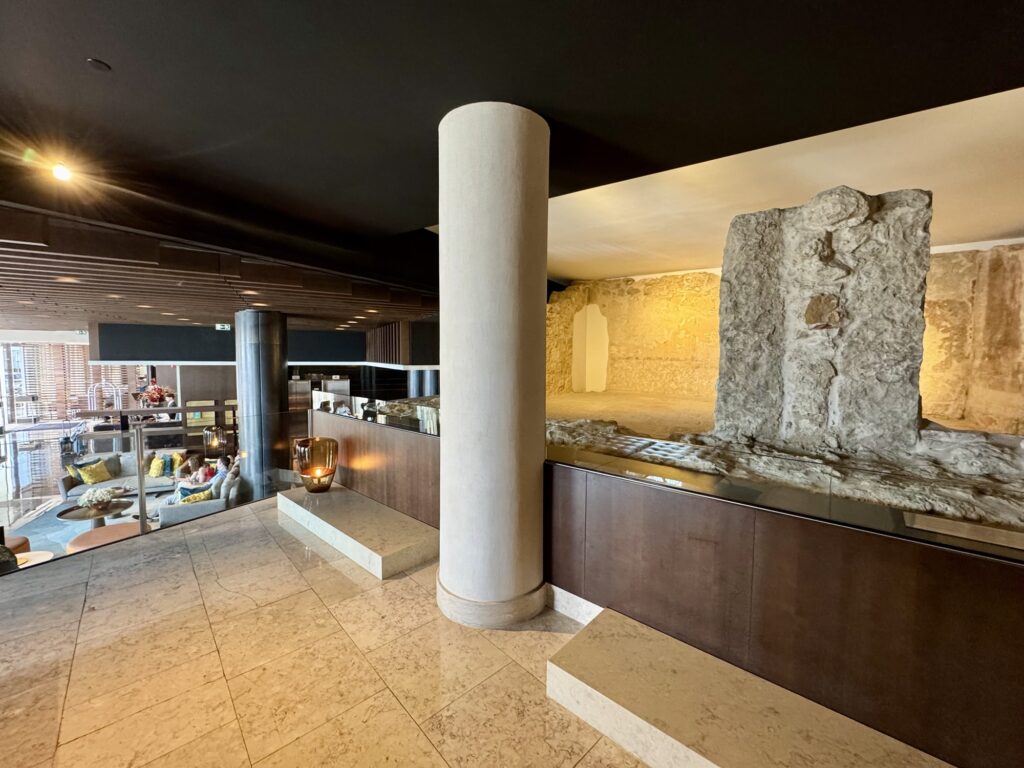
And here you see a whole room of a Roman house incorporated into the lobby space!
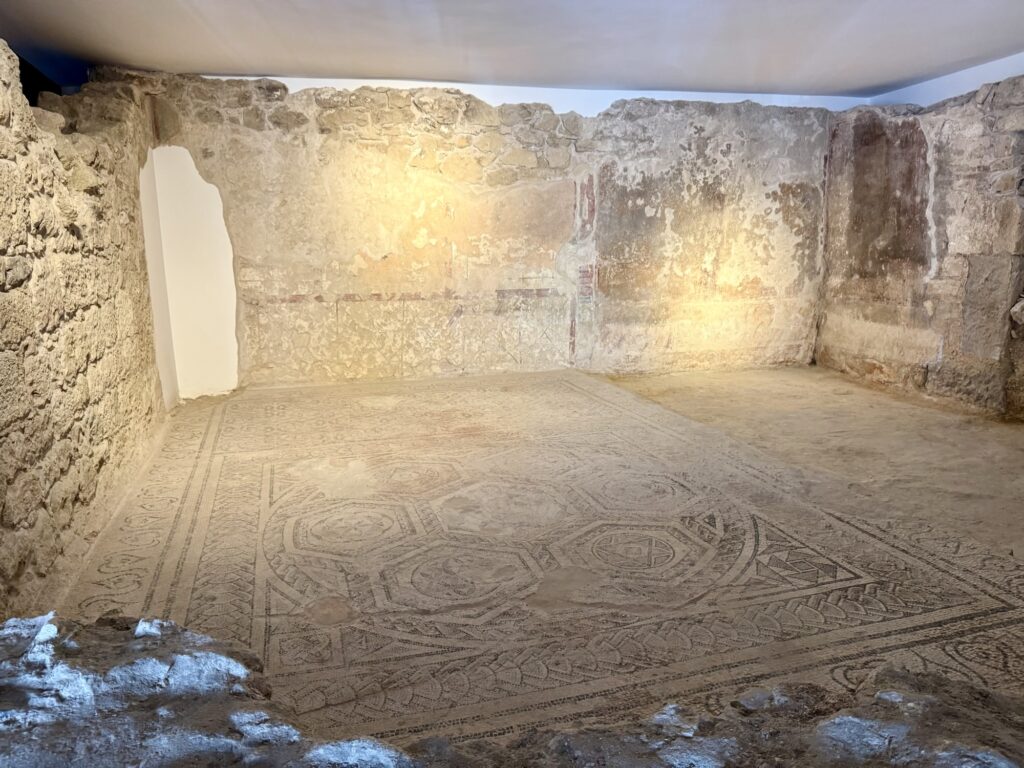
Looking into the Roman room, you can see there is an elaborate mosaic set into the floor. It is the only complete Roman mosaic in the city of Lisbon, and it’s in quite good shape! The design is a ring of six hexagons arranged around a portrait of Venus.
The raised position of the mosaic and the lighting make it hard to really see the image, but nearby placards and a video loop show the mosaic in better detail.
I’ve often found in Europe that archaeological sites are often treated as something to incorporate into life instead of being walled off in a museum, like we do in the USA. This tendency seems to be particularly strong here in Lisbon. There are several other places like this one where an archaeological site is just part of someone’s business. There’s even a bank across the street from our hotel where you can arrange to tour the ruins in their basement. (I hope to do this on Monday morning!) The Aurea Museum Hotel is one of the best examples I’ve seen of this.